
Nobody has to run the runtime
Camel runs where you put it — Spring Boot, Quarkus, Camel K on Kubernetes — and you patch, scale and page for it. iQBus is deployless in your Azure tenant: configuration goes live, no builds, no restarts.
Camel gives you every enterprise integration pattern — as a Java framework you build, host, monitor and keep on call for. iQBus delivers the same patterns as a configured product in your Azure tenant, live on save, with the tracking console included.
 iQBus · Azure-native ESB

 Available onAzure Marketplace
Two platform engineers at an evening desk with three monitors showing a message-flow dashboard and a log view, city lights outside
Integration teams that run on Cerebrum City engineering
















Camel runs where you put it — Spring Boot, Quarkus, Camel K on Kubernetes — and you patch, scale and page for it. iQBus is deployless in your Azure tenant: configuration goes live, no builds, no restarts.
Content-based routing, splitters, maps, retries, dead-letter handling — in Camel they are Java or YAML you write and test. In iQBus they are ports, pipelines and XSLT 3.0 maps you configure in the console.
With Camel you compose Hawtio, Micrometer, OpenTelemetry and a tracing backend. iQBus ships a flow tracking dashboard — every message, every port, suspended runs with one-click resume — and email alerts.
What each one meters, where it runs, what you build yourself and what comes in the box.
| Capability | Apache Camel | iQBus |
|---|---|---|
| What you pay for | No licence; your engineers' timeSupport via a Red Hat subscription if you want it | Cores you runStarter: no licence fee, ever — you pay only your own Azure |
| Where it runs | JVMs you operateSpring Boot, Quarkus, Camel K on Kubernetes | Managed in your Azure tenantDeployless; nothing to patch |
| How you build | Java / YAML DSL, CI/CDA Java bench on staff | Configure in the web consoleLive on save |
| Maps | Code, or libraries you integrate | XSLT 3.0 mapsVisual review, custom functions |
| EDI & HL7 | Camel components and third-party librariesWired, tested and maintained by you | EDI and HL7 in the runtimeIn production with customers today |
| Tracking & exceptions | Hawtio, Micrometer, OpenTelemetry — assembledDead-letter channels you code | One flow tracking dashboardSuspended runs, one-click resume |
| AI & agents | LangChain4j components; you host the model | AI Accelerator + MCP ServerBoth run in your tenant |
| Making a change | Code, build, test, redeploy | Configuration, liveNo builds, no deployment windows |
Comparison reflects each vendor's publicly documented capabilities and pricing pages as of October 2026; details change without notice, so confirm against the vendor before you decide. Apache Camel and the other product names are trademarks of their respective owners; iQBus is not affiliated with them.
Camel has a component for almost everything — and every one of them is code you write, test, run and watch. Tick what your estate needs and count the routes and components your team would own.
On iQBus you configureComponent names are from the Apache Camel component catalogue; EDI relies on third-party libraries. Camel has no licence fee — the count is engineering and operations work, not a bill. Based on each vendor's public documentation as of October 2026; confirm against the vendor before you decide. See iQBus pricing.
 Onboarding a new engineer
Senior developer
In Camel the whiteboard becomes Java and a build. In iQBus it becomes ports, a pipeline and a map in the console — and the new engineer can read the running flow on day one.
 3 a.m. page
On-call engineer
A suspended message in iQBus is a row in the console with a Resume button, not a JVM to inspect, a dead-letter queue to drain and a redeploy to schedule.
 Factory floor
Plant engineer
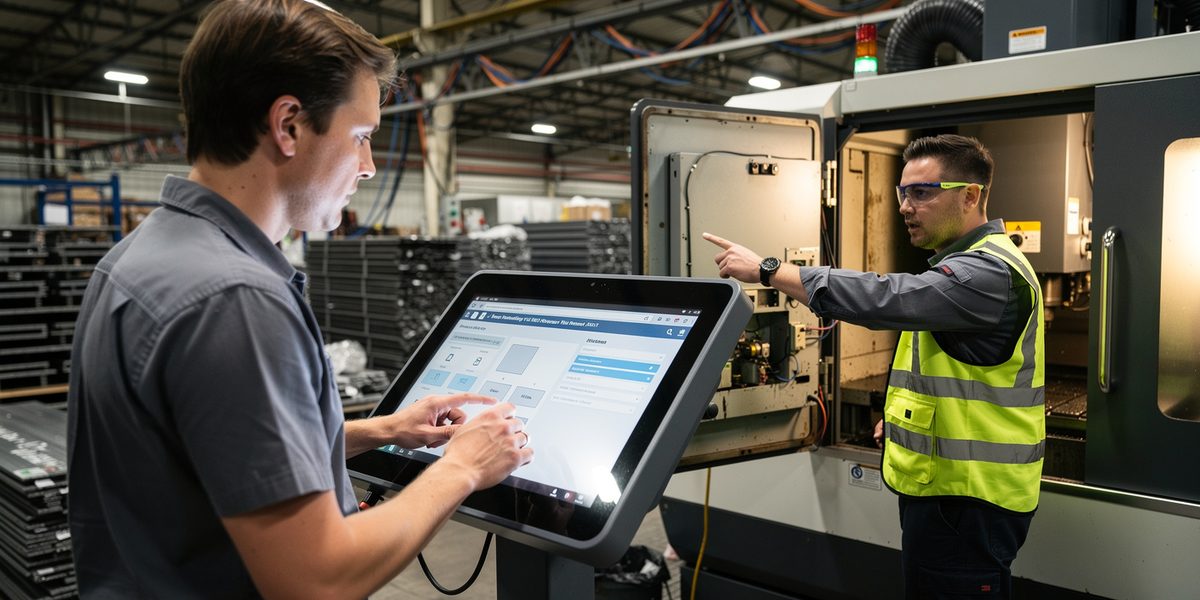
Production orders, confirmations and quality results move between MES and ERP all shift long. iQBus routes and maps them, retries per send port, and shows the plant engineer what went where.
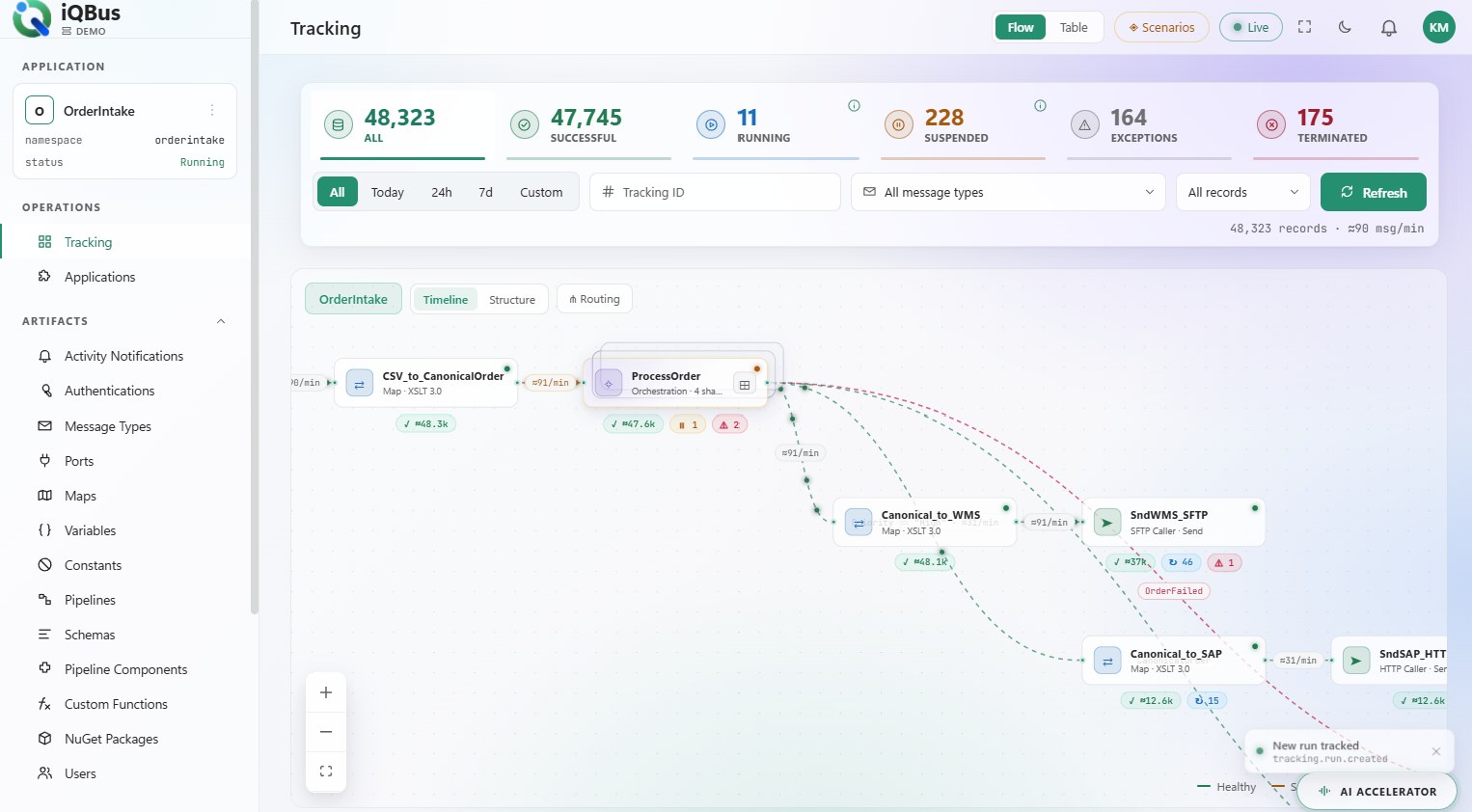
The iQBus console with sample data. Follow a message through every port, map and pipeline, open a suspended run and resume it — the part you would otherwise assemble from logs.
No sales cycle to start. Get iQBus from Azure Marketplace, create it in your subscription, sign in with Entra ID and configure your first integration. Starter has no licence fee, ever — you pay only your own Azure.
Starter no licence fee · Grow and Enterprise licensed per core · no per-message, per-connection or per-partner metering · pricing
If you are a Java shop with a platform team that wants integration as code in its own CI/CD and Kubernetes, Camel is a superb framework and you already have the people to run it. iQBus is for Microsoft-centred teams that want the same patterns delivered as a product — configured, tracked and supported — without owning the runtime.
Not sure which shape your estate is? Ask an architectiQBus has been a real asset to the business. Its intuitive interface allowed us to implement EDI effortlessly, and the built-in transaction tracking gives us the visibility to manage operations with confidence.
Cheryl Patterson, Chief of Staff, CPA, Novelty Inc.
Read the case study (PDF)
Send us your integration landscape — on Apache Camel, BizTalk or anything else. An integration architect returns a tailored map of what carries over, what changes and how a phased move would run.
You'll speak with a senior integration architect, not an SDR.
Still weighing it? Talk to an Integration Architect.
Further reading: The BizTalk alternative · BizTalk vs iQBus cost · iQBus pricing
Yes. Camel is an open-source Java framework that implements the enterprise integration patterns; you write routes in Java or YAML, build them, host them on JVMs and assemble monitoring around them. iQBus delivers the same patterns — routing, pipelines, XSLT 3.0 maps, adapters, retries, suspend and resume — as a configured product running inside your Azure tenant, with the tracking console included.
Camel has no licence fee; its cost is engineering and operations time — Java engineers to write and maintain routes, operators to patch, scale and watch the runtimes, and a support subscription if you want one. iQBus Starter also has no licence fee, and Grow and Enterprise are licensed per core; the runtime, console and support come with it, and Azure is billed to your own subscription.
No. Integrations are configured in the web console — ports, pipelines, maps, routing on promoted values — and go live on save. Custom pipeline components are C#, often drafted by the AI Accelerator, and the iQBus MCP Server lets your own AI agents build integrations with a person approving before go-live.
Each send port retries a fixed number of times at a fixed interval; what still fails is suspended and appears in the tracking console, where an operator can resume or terminate it with one click. In Camel you design redelivery policies and dead-letter channels in code and build the view yourself.
Get iQBus from Azure Marketplace and create it in your own subscription. Starter has no licence fee, ever — you pay only your own Azure. Or talk to an Integration Architect first and we will map your estate to iQBus with you.